In an era where online privacy has become a major concern, the temporary email address has rapidly transitioned from a niche developer utility into an essential privacy safeguard for everyday internet users. Every time you unlock a store discount, download a product manual, stream content, or register for public Wi-Fi, online platforms demand your personal email address. But few consumers realize the extensive profiling and data-mining operations triggered the moment they press "Submit."
In modern web architecture, your personal email is far more than a simple messaging mailbox; it serves as a central identifier tied to your online banking, retail accounts, and professional services. Disseminating your primary email across untrusted web forms exposes you to persistent marketing funnels and high-stakes data breaches. This is why disposable email platforms like 30mail.in have become indispensable.
What Exactly is a Temporary Email Address?
A temporary email address—also commonly referred to as a burner email, disposable email, or throwaway email—is an on-demand, self-destructing mailbox that operates without requiring your name, phone number, or password. Unlike permanent email accounts from Gmail, Yahoo, or Outlook, temporary inboxes are purposefully designed for transient, short-term interactions.
When you navigate to 30mail.in, a random, verified email address is generated instantly on your screen. You can copy the address, paste it into any web form or verification dialog, receive incoming emails or two-factor authentication (2FA) OTP codes in real time, and walk away. Once the designated session timer (10 minutes, 30 minutes, or 60 minutes) counts down to zero, the mailbox and every associated message are wiped clean from volatile server memory with zero lingering data footprints.
How Does Disposable Email Technology Function?
The engineering behind modern disposable email systems is straightforward yet sophisticated:
- Zero User Registration: You never surrender personal credentials, phone numbers, or credit card details. The session belongs exclusively to your current browser tab.
- Real-Time WebSocket Delivery: Traditional web services require manual page refreshing to check for new mail. Modern platforms like 30mail.in utilize persistent WebSocket streams that push incoming messages, links, and OTP tokens to your display within milliseconds of receipt.
- Volatile Memory Sandboxing: Rather than archiving emails to permanent disk storage, messages exist strictly in high-speed volatile cache. When your session timer concludes, the server triggers an automated garbage-collection routine that permanently purges the records.
- Receive-Only Architecture: To maintain strict sender reputation and comply with global anti-abuse protocols, reputable temporary mail providers operate exclusively in receive-only mode, completely eliminating outbound spam relay abuse.
Five Critical Reasons to Use a Disposable Email Address
1. Unlocking E-Commerce Promos and Store Discounts
Retailers frequently gate coupon codes (e.g., "Take 15% off your first online order") behind email capture boxes. If you only plan to purchase an item once, using a disposable email lets you receive the discount voucher without subjecting your personal inbox to months of promotional blitzes.
2. Peer-to-Peer Transactions and Classifieds
Communicating with prospective buyers or sellers on local marketplace apps carries inherent privacy risks. Sharing your permanent personal email address makes you vulnerable to credential stuffing, targeted phishing, and identity harvesting. A temporary address acts as a disposable buffer.
3. Gated Whitepapers, Software Demos, and Case Studies
Tech vendors and business platforms frequently require an email to view product webinars or research whitepapers. Once entered, your contact details are assigned to aggressive business-to-business (B2B) sales sequences. A throwaway email fulfills the download requirement without inviting persistent sales calls.
4. Airport and Hotel Wi-Fi Captive Portals
Public Wi-Fi access points across airports, hotels, and cafes often demand an email before authorizing internet connectivity. These portals monetize contact data by sharing it with marketing consortiums. A disposable email provides immediate Wi-Fi access while keeping your personal identity private.
5. Engineering, QA Testing, and Web Staging
Developers building authentication systems, automated sign-up flows, or password reset sequences need to test multiple distinct accounts simultaneously. Instead of managing dozens of slow, cumbersome test accounts, developers use temporary email APIs and inboxes to validate transactional message routing in seconds.
Evaluating Temporary Email Providers: Key Technical Benchmarks
Not all disposable email services deliver the same privacy and performance standards. When selecting a provider, evaluate these four criteria:
- Inbound Delivery Latency: Does the platform use real-time WebSockets, or are you forced to hit "Refresh" repeatedly? In modern OTP verification workflows where codes expire in 60 seconds, sub-3-second delivery is crucial.
- Data Retention and Destruction Policies: Look for platforms that openly document volatile memory processing. If a service stores messages on permanent disk, your transient communications could be retained indefinitely.
- Interface Cleanliness and Ad Intrusiveness: Many older temporary email sites are bloated with aggressive redirect ads, misleading "Download" buttons, and slow scripts that compromise browser performance. Choose clean, modern interfaces that prioritize user utility.
- Domain Diversity and Reputation: If a disposable provider only offers one heavily blacklisted domain, sign-up forms will reject the address instantly. High-quality services maintain diverse, well-configured domain pools with valid MX and SPF records.
Conclusion: Reclaiming Control Over Your Personal Inbox
Your personal email inbox is the gateway to your digital identity. By adopting the simple practice of using a disposable address from 30mail.in for transient interactions, you eliminate promotional clutter, minimize exposure in corporate data breaches, and take proactive control over your online privacy.
📊 How Temporary Email Works: Step-by-Step Architecture Chart
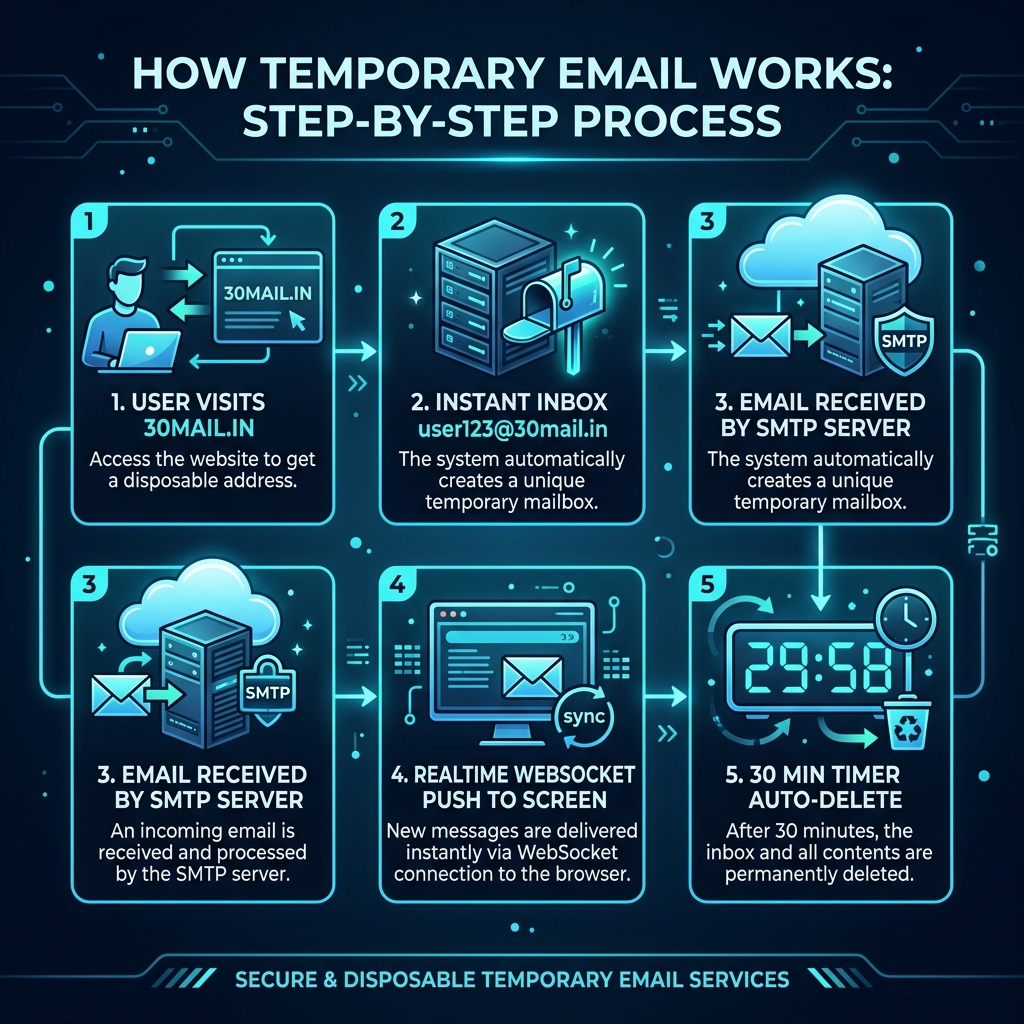
Architecture overview illustrating real-time WebSocket delivery and automatic memory deletion cycles at 30mail.in.
Frequently Asked Questions
Most temporary email services, including Free Mail, operate in receive-only mode to prevent spam relay abuse.
No. For your privacy and security, once the session timer expires, all messages are permanently erased from memory.
Yes. Free Mail is 100% free with no registration or payment required.