
Anyone who has navigated disposable email technologies over the past two decades has almost certainly encountered Guerrilla Mail. Established in 2006, Guerrilla Mail was an influential pioneer that proved the viability of on-demand, temporary inboxes. However, over the past twenty years, internet infrastructure, responsive front-end design, and cybersecurity protocols have evolved dramatically.
In this technical head-to-head comparison, we analyze how Guerrilla Mail compares to Free Mail (30mail.in) across architectural paradigms, real-time message delivery engines, mobile ergonomics, and developer testing features.
Architectural Comparison Overview
| Evaluation Dimension | Guerrilla Mail | Free Mail (30mail.in) |
|---|---|---|
| Foundational Framework | Legacy PHP / Traditional Stack (2006) | Modern Next.js & Node.js Reactive Stack |
| Delivery Mechanism | Periodic AJAX Polling (10-second cycles) | Instant Persistent WebSockets (Push) |
| Outbound Email Sending | Supported (Short text messages) | Disabled (Strict receive-only anti-abuse policy) |
| User Interface & Mobile UX | Fixed-width desktop interface | Clean, fully responsive, mobile-first design |
| Domain Reputation | High blocklist rate due to 19+ years of public activity | Actively curated, high-reputation domain network |
| Developer Test Utilities | Basic scrambled address string | Integrated Synthetic US Profile Generator |
Guerrilla Mail: Technical Strengths & Primary Use Cases
Guerrilla Mail's resilience and longevity command genuine respect. Its single most distinctive technical feature is its support for outbound email transmission. While nearly all modern disposable platforms operate exclusively as receive-only mailboxes to eliminate spam relay abuse, Guerrilla Mail allows users to compose and dispatch short outbound plain-text emails.
Key Strengths:
- Outbound Capability: Invaluable when an operational workflow requires dispatching an anonymous reply or confirming a handshake from a throwaway address.
- Scrambled Address Protection: Generates a random cryptographic alias for your mailbox name, preventing casual observers from snooping on your incoming mail stream if they guess your inbox prefix.
- Long-Standing Reputation: An established infrastructure that has operated reliably without significant downtime for almost two decades.
Free Mail (30mail.in): Modern Innovations & Advantages
30mail.in was engineered specifically to solve the limitations of first-generation disposable email services: latency lag, ad clutter, and rigid desktop-only layouts.
Key Strengths:
- Zero-Latency WebSocket Streaming: Rather than forcing users to manually refresh their browser or wait out a 10-second AJAX polling interval, 30mail.in pushes incoming verification emails and OTP tokens directly to the screen within milliseconds of delivery.
- High Deliverability & Curated Domains: Older services suffer from aggressive domain-level blocklists across major American platforms. 30mail.in regularly curates and monitors its active domain pool to maximize form acceptance rates.
- Receive-Only Safety Standard: By intentionally disabling outbound email composition, 30mail.in guarantees that its mail servers can never be hijacked for spam relays or phishing campaigns, safeguarding domain health and IP reputation.
- Integrated Developer Ecosystem: Engineered with software developers and QA automation engineers in mind. Users can pair temporary inboxes with our Synthetic US Profile Generator and Bulk Verifier to test registration flows seamlessly.
Strategic Verdict: Choosing the Right Platform
Both platforms fulfill distinct roles across different technical workflows:
- Select Guerrilla Mail when your specific project requires sending an anonymous outbound reply or when testing legacy mail servers that accept historic domain suffixes like
@sharklasers.com. - Select Free Mail (30mail.in) when you require instant OTP code reception, an uncluttered ad-free interface, seamless mobile responsiveness, and high form acceptance rates across modern US websites and apps.
📊 Traditional Email vs. Temporary Email Privacy Architecture Chart
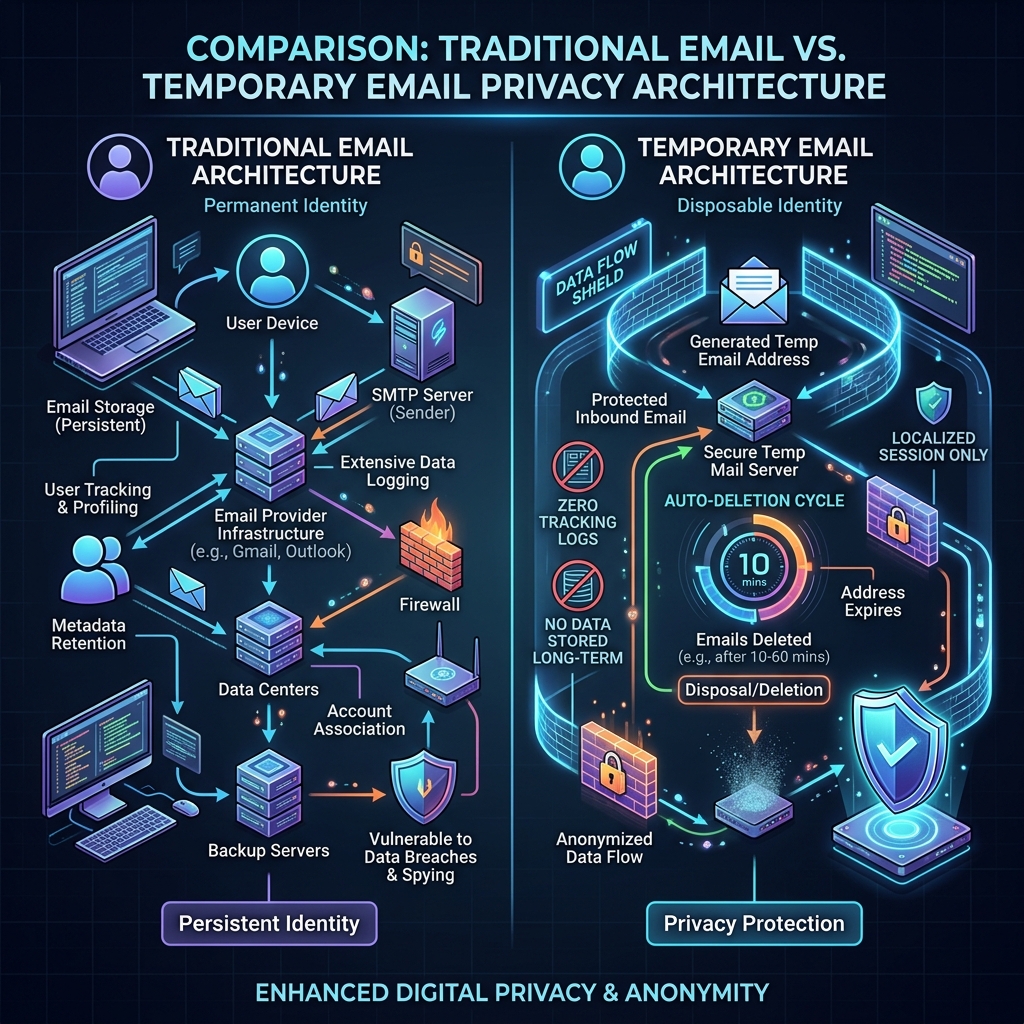
Architecture overview illustrating real-time WebSocket delivery and automatic memory deletion cycles at 30mail.in.
Frequently Asked Questions
Modern services use WebSockets for real-time delivery, whereas traditional tools rely on periodic AJAX polling cycles.
Guerrilla Mail supports sending short text messages, while Free Mail is receive-only to maintain strict spam prevention standards.