
In modern corporate America, enterprise security monitoring and cybersecurity compliance standards have reached unprecedented levels of rigor. With platforms like CrowdStrike, Microsoft Defender, and enterprise Data Loss Prevention (DLP) inspecting corporate endpoints and network traffic, many professionals wonder where legitimate privacy boundaries begin and end. When is it appropriate to deploy a secondary or disposable email address for work-related research, and when must you strictly adhere to corporate email channels?
Navigating this boundary requires nuance: while temporary email platforms like 30mail.in are invaluable for shielding your work inbox from relentless B2B vendor cold-calling, market research spam, and external webinar follow-ups, deploying unauthorized personal addresses for sensitive corporate communications can trigger serious security violations.
Understanding Enterprise IT Monitoring & Workplace Privacy Realities
When operating on an employer-issued laptop, phone, or VPN connection, your digital footprint is governed by corporate Acceptable Use Policies and enterprise security architecture:
- Corporate Email Ownership: Employer-provided email accounts (e.g.,
sarah@company.com) are the legal property of the organization. Corporate IT administrators possess statutory authority to search, audit, and archive all incoming and outgoing messages to satisfy legal discovery, SOC 2 compliance, and regulatory mandates. - DNS & Secure Web Gateway Logging: Enterprise VPNs and zero-trust network access (ZTNA) gateways record external domain connections, DNS lookups, and session timestamps across all connected corporate devices.
- Automated Data Loss Prevention (DLP): Corporate security agents continuously scan outbound attachments, clipboard pastes, and text transmissions to prevent proprietary intellectual property, trade secrets, and customer personally identifiable information (PII) from leaking outside the corporate firewall.
Three Legitimate Professional Use Cases for Disposable Inboxes
There are distinct, high-value professional scenarios where deploying a disposable or secondary email address is not only acceptable, but considered best practice:
1. Accessing Vendor Whitepapers, Tech Demos & Industry Webinars
Downloading an enterprise software whitepaper or registering for an industry tech webinar almost invariably routes your contact info into high-pressure B2B sales automation sequences (Salesforce, HubSpot, Outreach). Within hours, sales development reps (SDRs) begin bombarding your corporate inbox with persistent cold calls and calendar booking requests. Using a temporary address on 30mail.in allows you to review the technical documentation without inviting weeks of aggressive sales prospecting into your daily work queue.
2. Competitive Benchmarking & Market Intelligence
If your role involves product management, market research, or UX design, you often need to audit competitor onboarding flows, pricing calculators, or public newsletter distributions. Signing up with your verified corporate domain immediately flags your research to their business intelligence team. Using a neutral secondary or disposable inbox ensures unbiased, unhindered observation.
3. Anonymous Industry Compensation & Culture Surveys
When contributing compensation data or workplace feedback to external salary benchmarking platforms (e.g., Levels.fyi, Glassdoor, Blind), using your corporate email can inadvertently associate your submissions with your employer's domain. A secondary or temporary inbox guarantees that your career insights remain completely decoupled from internal corporate monitoring.
High-Risk Scenarios to Strictly Avoid
Conversely, utilizing external or temporary emails in the following contexts can lead to immediate compliance infractions or disciplinary action:
- Statutory HR, Payroll & Benefits Records: Never utilize a temporary email for payroll distribution, federal tax reporting (W-2s, 1099s), 401(k) retirement administration, or formal nondisclosure agreements (NDAs). These compliance documents require authenticated, long-term records.
- Transmitting Proprietary Code, Customer PII, or Financials: Forwarding internal company presentations, customer databases, source code repositories, or proprietary financial forecasts to an external personal or disposable inbox is a severe violation of intellectual property agreements.
- Bypassing Corporate Procurement Protocols: Attempting to sign up for unsanctioned shadow-IT software licenses using disposable addresses circumvents mandatory IT security and SOC 2 vendor vetting.
Workplace Email Usage Decision Matrix
| Workplace Scenario | Recommended Communication Channel | Rationale & Compliance Requirement |
|---|---|---|
| Direct Customer & Client Correspondence | Official Corporate Email | Maintains professional credibility, legal accountability & audit trails. |
| Payroll, W-2 Forms & Health Benefits | Official Corporate or Verified Personal Email | Permanent documentation required for statutory IRS tax compliance and HIPAA records. |
| External Tech Whitepapers & Vendor Demos | Temporary Email (30mail.in) | Prevents B2B SDR sales harassment and marketing clutter from invading work inboxes. |
| Competitor Funnel Audits & Market Research | Neutral Secondary Email or 30mail.in | Prevents competitors from detecting exploratory corporate research. |
| Software QA Registration & OTP Testing | 30mail.in + Synthetic US Profile Generator | Enables fast, isolated verification testing without contaminating production email records. |
Conclusion
Modern professionals must navigate the intersection of workplace transparency and personal privacy with deliberate care. By utilizing official company channels for all formal business operations while leveraging 30mail.in as a protective buffer against external marketing clutter and vendor sales sequences, you maintain impeccable workplace compliance while preserving an organized, productive inbox.
📊 Traditional Email vs. Temporary Email Privacy Architecture Chart
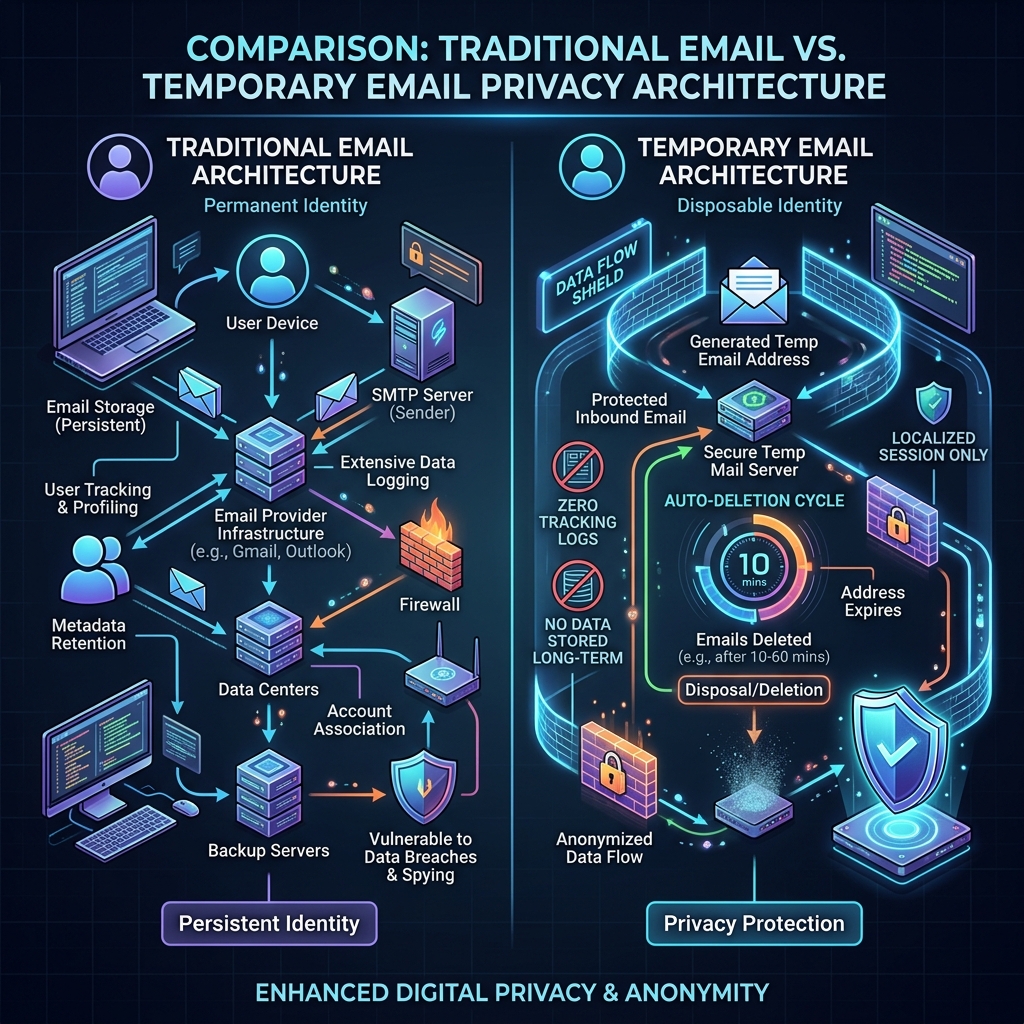
Architecture overview illustrating real-time WebSocket delivery and automatic memory deletion cycles at 30mail.in.
Frequently Asked Questions
Corporate web filters log visited URLs on company networks, but encrypted HTTPS/WebSocket contents remain private.
Yes. Using neutral secondary inboxes for market benchmarking and vendor whitepapers is a standard industry practice.