
The modern internet has transformed into an aggressive data collection arena. Between promotional sales blasts, intrusive marketing trackers, and mandatory account registrations for everyday utilities, preserving a pristine personal inbox requires deliberate strategy. For American consumers and software engineers alike, temporary email services provide a practical, disposable shield against unwanted marketing solicitations. But with dozens of disposable mail providers operating across the web, how do the leading platforms compare in reliability, speed, and privacy?
In this comprehensive 2026 technical analysis, we evaluate ten prominent disposable email services. We examine each provider across critical performance metrics including domain variety, message delivery latency, inbox lifespans, user experience, and anti-spam architectural standards.
Benchmarking & Evaluation Criteria
To ensure an objective, data-driven comparison, our evaluations focus on five primary dimensions:
- Domain Diversity & Reputation: The breadth of active domain suffixes offered and whether these domains are readily accepted by modern web verification forms.
- Delivery Latency (WebSocket vs. Polling): How quickly incoming verification codes (OTPs) and account activation links appear on the user's screen.
- Data Retention & Privacy Policies: How rigorously the platform handles message purging and whether server logs or IP addresses are retained.
- Cross-Device User Experience: Interface clarity, mobile optimization, zero obstructive ad layouts, and 1-click clipboard ergonomics.
- Developer & Testing Capabilities: Support for custom aliases, synthetic profile generation, and testing automation.
2026 Temporary Email Service Comparison Matrix
| Provider | Domain Availability | Inbox Duration | Delivery Engine | Custom Alias |
|---|---|---|---|---|
| Free Mail (30mail.in) | Multiple Curated Domains (@30mail.in) | 10, 30, or 60 Minutes | Real-Time WebSockets | Yes (Free) |
| Guerrilla Mail | 11 Shared Suffixes | 60 Minutes | Polling (AJAX) | Yes |
| 1secMail | 8 Public Domains | Session-Based | Polling / REST API | No |
| Mailinator | Public Pool (@mailinator.com) | 2 to 4 Hours | Server Stream | Any Public Name |
| TempMail.org | Rotated Pool | Manual Purge | Polling | Paid Subscription Tier |
| Throwam (Throwawaymail) | Single Active Suffix | 48 Hours | Periodic Refresh | No |
| Mail.tm | Rotated Cloud Domains | Token-Based Session | SSE / REST API | Programmatic API |
| YOPmail | Multi-Domain Network | 8 Days Retention | Manual Fetch | Any Public Alias |
| Dispostable | Single Domain (@dispostable.com) | 24 Hours | Manual Refresh | Custom Prefix Only |
| TrashMail | Forwarding Alias Network | Forward Limit (1-30 Days) | SMTP Relay | Yes |
In-Depth Provider Evaluations
1. Free Mail (30mail.in) — Best Overall for Speed & Clean Usability
30mail.in is engineered specifically for instantaneous, distraction-free temporary inbox generation. Powered by Next.js and high-throughput Node.js WebSocket pipelines, incoming messages and verification codes appear on screen in real time without requiring manual browser refreshing.
- Notable Advantages: Real-time WebSocket delivery eliminates lag during time-sensitive OTP account activations; configurable 10, 30, and 60-minute duration tiers; custom alias creator for tailored testing; zero intrusive popups; integrated with a Synthetic US Profile Generator for software QA testing.
- Trade-Offs: Strictly receive-only by design to prevent outbound spam relaying; addresses auto-delete permanently upon timer completion.
2. Guerrilla Mail — The Veteran Open-Source Platform
Operating continuously since 2006, Guerrilla Mail is one of the oldest disposable email platforms on the web. It is widely recognized for memorable domain options like @sharklasers.com and uniquely offers outbound email composition for short text communications.
- Notable Advantages: Generates inboxes for a full 60 minutes; supports outbound text email sending; open-source heritage.
- Trade-Offs: Because its domains have been public for nearly two decades, many commercial websites maintain hardcoded blocklists that reject Guerrilla Mail addresses; interface retains legacy early-2000s styling.
3. 1secMail — Lightweight Developer Favorite
1secMail strips away elaborate front-end formatting to deliver a high-speed, programmatic platform. It is particularly popular among backend engineers who require automated scripts to poll for incoming confirmation emails via simple HTTP GET requests.
- Notable Advantages: Documented, public JSON API with zero authentication barriers; extremely fast response payloads.
- Trade-Offs: The browser user interface is austere, lacking modern responsive elements or automated clipboard utilities.
4. Mailinator — The QA & Automated Testing Industry Standard
Mailinator operates on a unique public-access architecture: every imaginable address ending in @mailinator.com exists simultaneously. You do not need to create an inbox prior to receiving mail—simply navigate to the specific mailbox name to view its contents.
- Notable Advantages: Exceptional for continuous integration (CI/CD) pipelines, enterprise test automation, and web scraping verification.
- Trade-Offs: All public inboxes are unauthenticated and completely visible to anyone who enters the inbox name. Never use Mailinator for private communications or real account setups.
5. TempMail.org — Popular Mobile & App Ecosystem
TempMail.org is one of the most recognized consumer brand names in disposable mail, offering polished mobile apps on Google Play and Apple's App Store.
- Notable Advantages: Slick native mobile UI; wide international awareness; extensive domain rotation.
- Trade-Offs: Advanced features such as custom address creation, multiple simultaneous inboxes, and ad removal require a monthly paid premium subscription.
6. Throwam (Throwawaymail) — Single-Click Simplicity
Throwam focuses entirely on single-purpose utility. Visiting the homepage generates an active 48-hour address with zero configuration steps required.
- Trade-Offs: Lacks domain switching or custom alias options; limited formatting controls for rich HTML emails.
7. Mail.tm — Modern API Architecture
Mail.tm provides a clean REST API and Server-Sent Events (SSE) stream for programmatic mailbox management. Developers can create accounts, generate JWT auth tokens, and process incoming payloads smoothly.
- Trade-Offs: Geared primarily toward developers; general non-technical consumers may find account token management less intuitive than 1-click inboxes.
8. YOPmail — Extended Multiday Message Retention
While most temporary mail providers purge messages within minutes or hours, YOPmail stores incoming messages for up to 8 days. This extended window is useful when awaiting delayed responses or multi-day software trial confirmations.
- Trade-Offs: Inboxes are publicly readable without password protection; interface contains dense banner ad units.
9. Dispostable — Minimalist Manual Lookup
Dispostable lets users manually type any desired mailbox name directly into the URL or search bar to inspect incoming mail. It provides a clean, bare-bones experience.
- Trade-Offs: Relies primarily on a single domain suffix (
@dispostable.com), which is widely filtered by modern anti-disposable firewalls.
10. TrashMail — Secure Email Forwarding Hub
Unlike standalone web inboxes, TrashMail functions as an intelligent email forwarder. It generates an alias that relays incoming messages directly to your real personal inbox for a pre-configured number of forwards or time window before self-terminating.
- Trade-Offs: Requires entering your genuine email address during setup to configure forwarding routes; free tier imposes limits on message forwarding volume.
Strategic Recommendations: Selecting the Optimal Tool
Choosing the right disposable email platform depends on your specific operational use case:
- For Immediate, Responsive Verification: 30mail.in provides real-time WebSocket delivery, clean modern styling, and zero registration.
- For Large-Scale Developer Automated Testing: Mailinator and Mail.tm offer mature API endpoints tailored for CI/CD pipelines.
- For Outbound Disposable Communication: Guerrilla Mail remains the standard choice when outbound replies are strictly necessary.
- For Extended Multiday Access: YOPmail offers an 8-day retention window for delayed confirmation cycles.
📊 Traditional Email vs. Temporary Email Privacy Architecture Chart
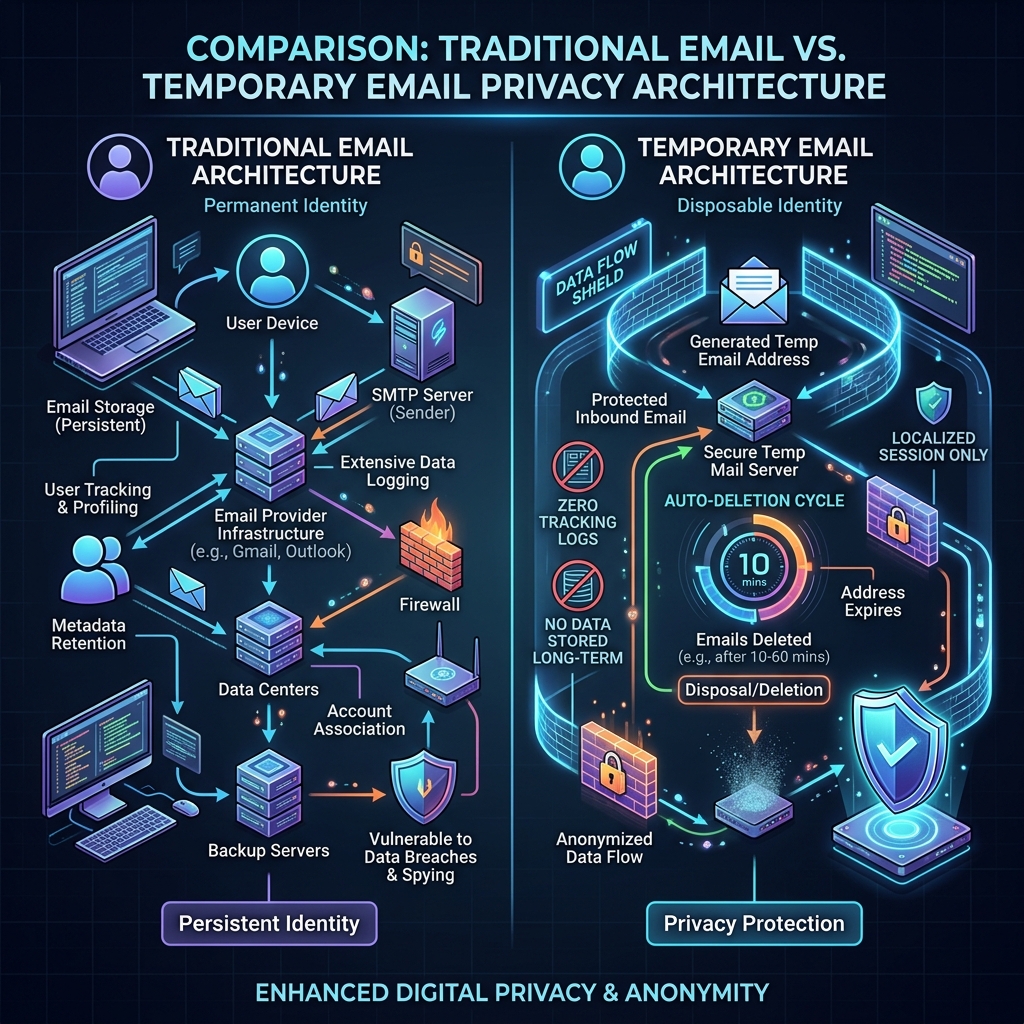
Architecture overview illustrating real-time WebSocket delivery and automatic memory deletion cycles at 30mail.in.
Frequently Asked Questions
Some platforms maintain lists of public disposable domains to ensure users provide reachable contact information. Rotating domains helps testing.
Most reputable disposable email services operate strictly in receive-only mode to prevent outbound spam relays.